
Zodiac Myths
When I first learned that Virgo is the second largest constellation in the night sky, I felt curious about how so many different cultures gave meaning to the same cluster of stars. Every time I traveled across Europe or read about its myths, I noticed how Virgo appeared in different shapes sometimes as a grieving maiden, sometimes as a goddess of justice, and at other times as the Virgin Mary herself.
What struck me most was how the constellation was not just about stars; it was about the rhythm of seasons, the hope for justice, the purity of love, and the sadness of loss. In this essay, I will explore Virgo myths in ten European countries while also sharing how I experienced them personally, whether through travel, art, or stargazing on quiet nights.
1. Greece: Persephone, Demeter, and the Eternal Cycle
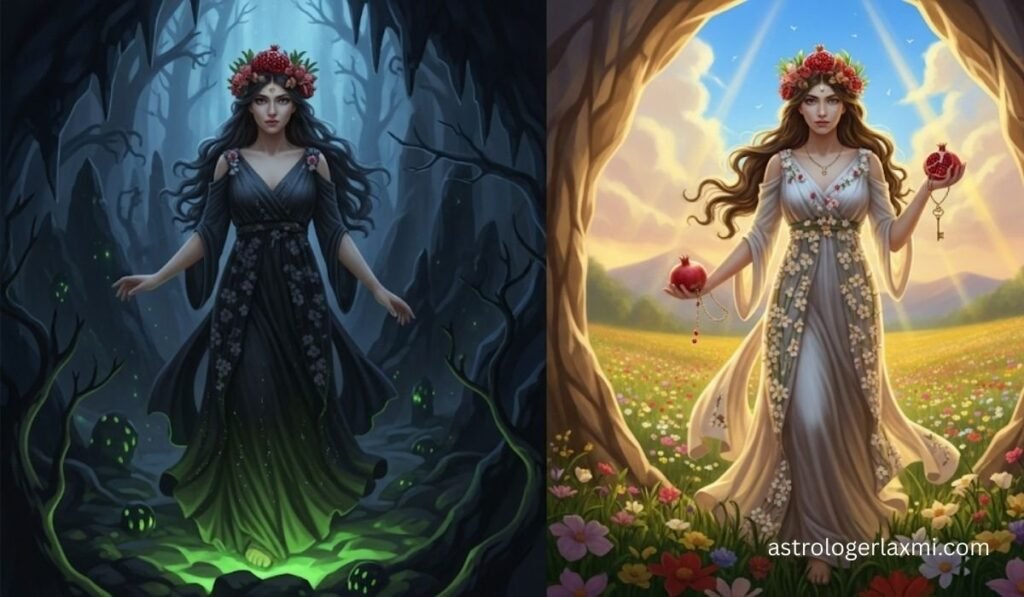
My first encounter with Virgo myths was in Athens, standing on the Acropolis one summer night. The stars above seemed brighter against the dark ruins. I remembered the Greek myth of Demeter and Persephone—how the abduction of Persephone by Hades explained the changing seasons. Demeter’s grief caused the earth to wither, and her joy brought life back when Persephone returned. Virgo, the maiden, seemed to embody Persephone herself, forever caught between two worlds.
Another story I found equally moving was that of Erigone, the daughter of Icarius, who hanged herself out of grief when her father was killed. I remember reading this while sitting at a café in Athens, and suddenly Virgo’s stars felt heavier, as if carrying not only beauty but sorrow. For me, the constellation became a reminder of how grief can shape legends and how people turn tragedy into something immortal—literally written in the sky.
2. Italy: Ceres and Proserpina in Roman Memory
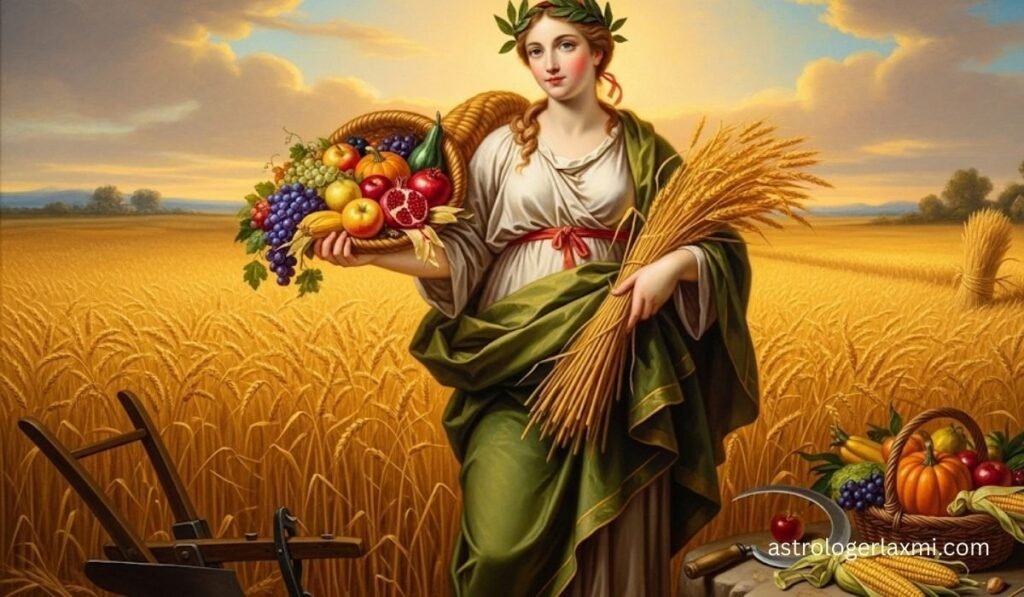
When I visited Rome, I walked through the ruins of the Forum and noticed carvings of wheat on ancient stones. It reminded me of Virgo’s Roman counterpart, Ceres, the goddess of grain. Just like the Greeks, the Romans told of Proserpina’s abduction, and Virgo became a celestial marker of harvest and rebirth.
In Italy, I felt Virgo not only as a myth but as a presence in art. While touring old churches, I saw frescoes where maidens held sheaves of wheat—symbols of both Virgo and the Virgin Mary. It struck me how fluid mythology can be: the same Virgo who once represented Ceres later became a reflection of Christian purity. My own walk through those churches felt like moving through layers of time, from pagan Rome to medieval faith.
3. France: Virgo as the Virgin Mary
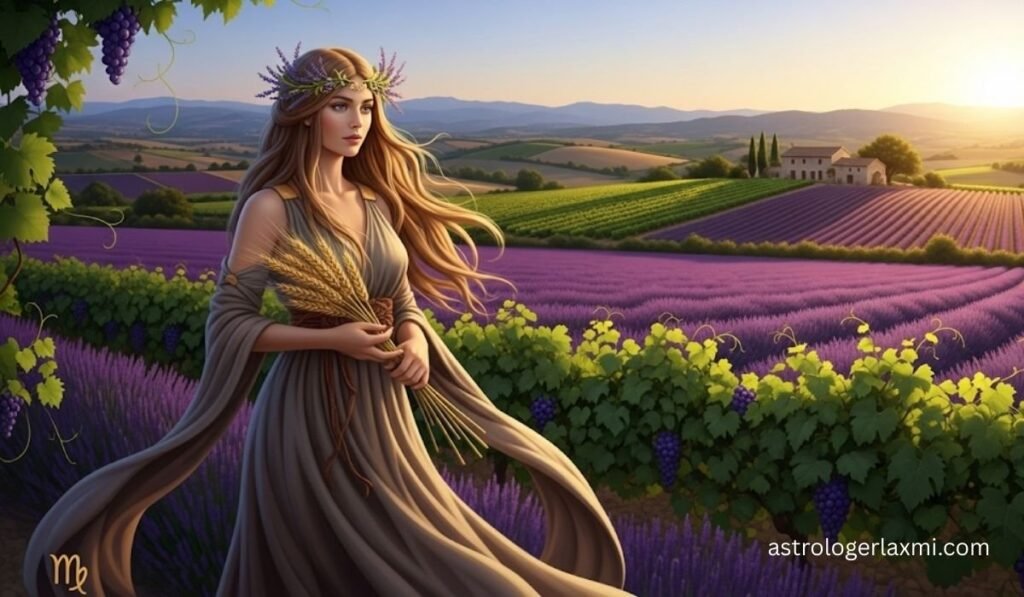
One autumn, I stood inside Chartres Cathedral in France, staring at the zodiac carvings around the famous royal portal. There she was Virgo, the maiden, standing proudly with a sheaf of wheat. But in this place, she wasn’t just Demeter or Astraea; she had been transformed into the Virgin Mary.
I remember feeling a shiver of awe. It was as if the ancient constellation had been baptized into Christianity, carrying with it both the agricultural cycle and divine purity.
For me, Virgo in France symbolized continuity a reminder that myths don’t disappear, they evolve. As a traveler, I felt humbled seeing how a medieval church could carry both the echo of ancient harvest rites and the reverence of Christian devotion.
4. United Kingdom: Virgo in Medieval Art
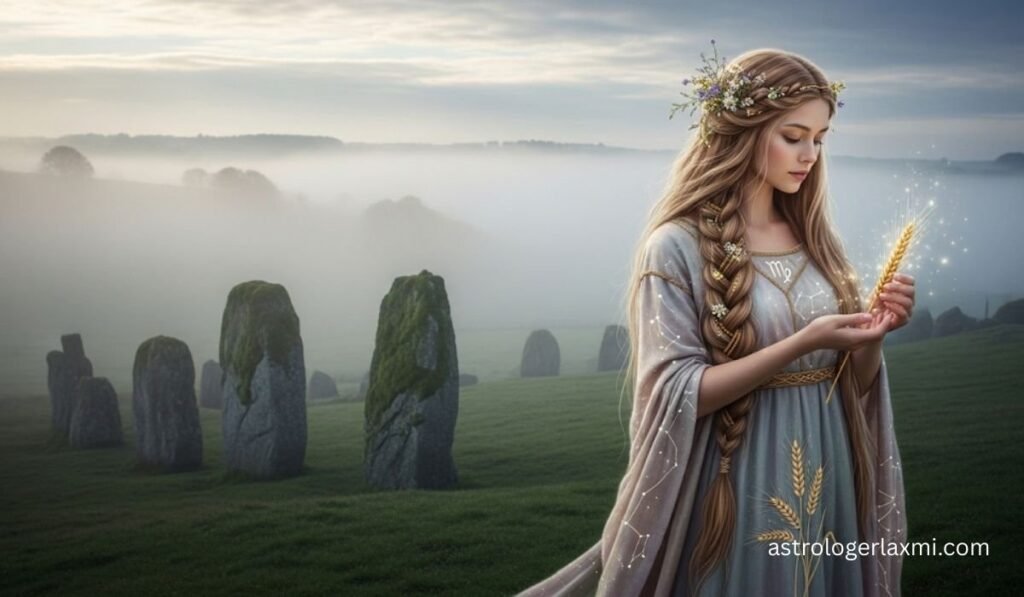
In England, during a visit to the York Minster, I noticed stained-glass windows decorated with zodiac signs. Virgo was there again, often shown as a pure maiden holding wheat. What fascinated me was how deeply these symbols were tied to both religion and agriculture.
Walking through the countryside later that evening, I saw fields of golden barley swaying in the wind. Suddenly, Virgo’s myths didn’t feel distant at all. They were right there in the fields, in the rhythm of planting and harvesting.
It made me realize that constellations like Virgo weren’t abstract stories but practical guides, helping people know when to sow and when to reap. My personal connection came through that countryside walk it was as if Virgo was watching over the land, ensuring its cycles.
5. Germany: Virgo in Manuscripts and Cathedrals
When I traveled to Cologne, I saw medieval manuscripts on display that included zodiacal calendars. In them, Virgo was drawn as a maiden with flowing robes, sometimes holding a lily, other times wheat. In Germany, Virgo had taken on the dual role of agricultural maiden and symbol of Christian virtue.
I remember sitting quietly inside Cologne Cathedral, where the Virgin Mary was honored in almost every corner. Virgo’s presence here felt subtle but strong. Personally, I felt a connection between the scholarly, orderly side of Virgo in astrology and the precision with which German cathedrals were built every stone carefully placed, every line symmetrical. It reminded me that myths often reflect the values of a culture: for Germany, Virgo mirrored both faith and discipline.
6. Spain: Virgo and Marian Festivals
In Spain, my experience with Virgo came not from a cathedral but from a festival. I visited Valencia during the feast of the Assumption of Mary, and the imagery of a maiden crowned with stars immediately brought Virgo to mind. The blending of Virgo’s symbolism with the Virgin Mary was especially visible here: she was celebrated as both a mother and a maiden, pure yet powerful.
For me, Spain showed Virgo in a festive light. Standing in a crowded square filled with music, flowers, and candles, I realized how Virgo was no longer only a myth from ancient times but a living presence in European culture. It was beautiful to see how mythology could become part of everyday life, celebrated not in hushed tones but in joyous parades.
7. Greece (Orthodox Tradition): Virgo as Theotokos
When I returned to Greece years later, this time visiting Thessaloniki, I noticed how Virgo’s symbolism had continued into Orthodox Christianity. Icons of the Theotokos (Mother of God) carried imagery reminiscent of Virgo: purity, compassion, and often, stars.
One evening, walking along the Aegean coast, I looked up at the September sky where Virgo shines most clearly. I felt as if the old Greek myths and the Orthodox traditions were coexisting. To me personally, this was powerful: the same stars had been Persephone, Astraea, and now Mary. My experience here reinforced the idea that myths are not erased by new beliefs—they are absorbed, reshaped, and carried forward.
8. Scotland: Echoes of Celtic Harvest Goddesses
In Scotland, I did not find direct carvings of Virgo in churches, but I found her echoes in Celtic harvest myths. Stories of grain maidens, fertility goddesses, and seasonal cycles reminded me of Virgo’s essence. On a hike in the Highlands, with golden grasses stretching as far as I could see, I imagined how ancient Celts must have looked at Virgo’s stars as a sign that harvest was near.
Personally, this was one of the most grounding experiences. Away from cities and cathedrals, the land itself told the story. Virgo here was not just in myth or religion but in the soil, the crops, and the wind. I felt connected not only to history but to the earth itself.
9. Lithuania: Baltic Echoes of the Harvest
In Lithuania, though Virgo wasn’t named directly in folklore, I discovered how Baltic traditions connected stars to agriculture. The Pleiades were seen as guides for sowing and harvesting, and Virgo, with her wheat imagery, fit naturally into this worldview.
When I visited Vilnius and later a small rural village, I saw how central harvest festivals still were to local culture. Standing under the night sky after one such festival, I felt Virgo’s presence even if the locals didn’t name her. For me, it showed that mythology doesn’t need to be explicit to be alive; sometimes it is hidden in traditions, songs, and the rhythm of farming life.
10. Slavic Regions: Virgo in Seasonal Beliefs
My journey also took me into Eastern Europe, where Slavic traditions placed great importance on stars as agricultural markers. While Virgo was not always singled out, the constellation’s timing—rising in late summer—was naturally tied to the harvest season.
In Poland, I joined a harvest celebration where bread made from the first wheat was blessed in church. As the priest lifted the bread, I thought of Virgo holding wheat in so many depictions across Europe. It felt like the ancient myth and the Christian blessing were one and the same. Personally, this was one of the most striking moments: Virgo was no longer a distant constellation but a living cultural symbol woven into daily ritual.
11. Virgo Greek God Mythology
- Virgo means “the maiden” or “virgin.” The constellation has long been linked with harvest and agriculture because it rises during the time of the year when crops are gathered.
- In Greek mythology, Virgo is most often connected to Demeter, the goddess of harvest, agriculture, and fertility. She rules over the cycles of growth, planting, and reaping.
- Sometimes Virgo is also linked to Persephone, Demeter’s daughter, whose myth explains the changing of the seasons (spring and summer when she is above the earth, autumn and winter when she is in the underworld with Hades).
- Another association is with Astraea, the virgin goddess of justice and purity, who lived among humans during the Golden Age. When the world became corrupt, she returned to the heavens and became the constellation Virgo.
Symbolism for Virgo in Astrology
Cycles of change → Persephone’s story connects Virgo to transformation, seasonal shifts, and renewal.
Purity and service → Like Astraea, Virgo represents innocence, integrity, and a desire to bring order.
Harvest and practicality → Like Demeter, Virgo reflects nourishment, attention to detail, and care for daily life and growth.
Zodiac Myths: The Story Behind Virgo
| Theme | Details |
|---|---|
| Constellation Symbol | Virgo is often represented as a maiden holding wheat, symbolizing harvest, purity, and wisdom. |
| Greek Myth | Linked to Astraea, the goddess of justice and innocence. She lived among humans during the Golden Age but left Earth when it became corrupted, rising to the skies as Virgo. |
| Roman Myth | Associated with Ceres (Demeter), the goddess of agriculture. Virgo’s wheat symbol connects to harvest and fertility. |
| Babylonian Myth | Connected to Shala, the goddess of grain and compassion, often shown holding an ear of corn. |
| Egyptian Myth | Related to Isis, the goddess of life, motherhood, and magic, who was sometimes depicted with sheaves of wheat. |
| Symbolism | Purity, harvest, justice, wisdom, and renewal. Virgo blends human qualities with divine order. |
| Seasonal Meaning | Virgo rises in the night sky during late summer and early autumn, marking the time of harvest. |
| Personality Traits (Myth-inspired) | Analytical, caring, hardworking, and seeking truth and justice—like Astraea and Ceres. |
Conclusion
As I traveled through these ten European countries—Greece, Italy, France, the United Kingdom, Germany, Spain, Greece again through Orthodox tradition, Scotland, Lithuania, and the Slavic regions—I realized that Virgo is more than just stars.
She is Persephone and Demeter, marking the sorrow and joy of the seasons. She is Erigone, forever grieving in the sky. She is Astraea, a goddess of justice who left a corrupt world. She is Mary, the Virgin, honored in cathedrals and festivals. She is also the silent guardian of fields, the unseen spirit of harvests, and the unspoken rhythm of rural life.
For me personally, Virgo became a traveling companion. Whether in the ruins of Athens, the churches of Rome, the cathedrals of France, the fields of Scotland, or the villages of Lithuania, she was always there—sometimes in myth, sometimes in art, and sometimes in the stars themselves.
What began as curiosity about a constellation turned into a journey of connection, showing me how one group of stars could hold so many layers of meaning across cultures and centuries.