
Ashtakoot Points for Mrigashira and Magha Nakshatra
When we talk about marriage in Vedic astrology, one of the most important steps is checking the compatibility between the bride and groom. This process is called Kundli Milan or horoscope matching. Out of many systems, the Ashtakoot Milan system is one of the most widely used. It is based on the nakshatras of the bride and groom’s Moon sign.
Recently, I came across a case where one person had Mrigashira nakshatra and the other had Magha nakshatra. I thought it would be helpful to write about how these two nakshatras work together according to the Ashtakoot system. In this post, I will go into detail about the points (gunas) they get in different categories, what it means, and my personal thoughts on it.
Understanding Ashtakoot Matching
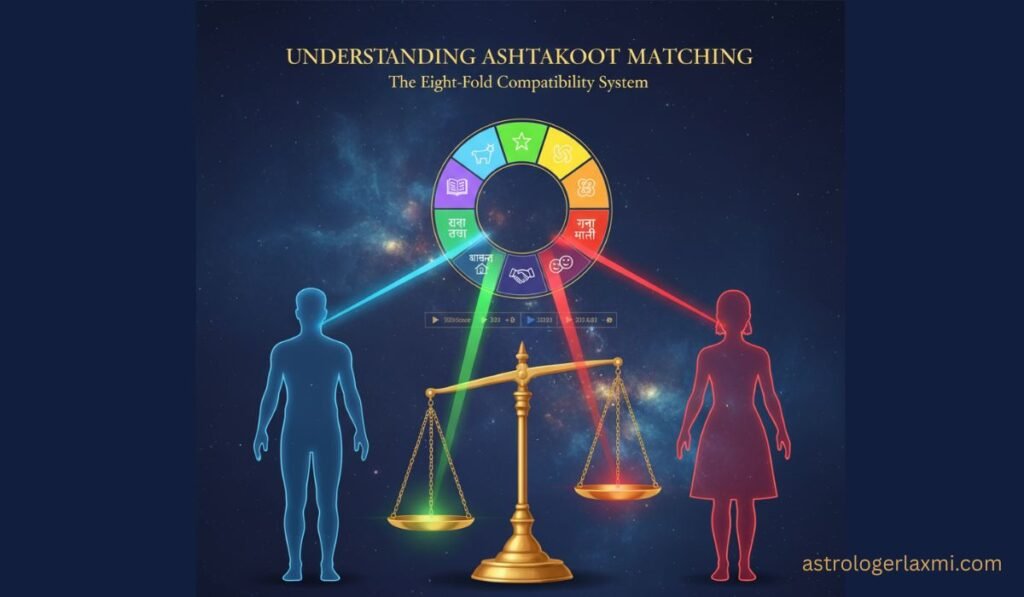
Before we jump into the specific points for Mrigashira and Magha, let us understand what Ashtakoot means.
The word “Ashta” means eight, and “Koot” means categories or aspects. In Vedic astrology, the Ashta Koot Milan system is one of the most important methods used to match the horoscopes of a bride and groom before marriage. It helps determine how compatible two individuals are in terms of personality, emotions, health, and destiny.
In this system, the compatibility between the bride and groom is analyzed under eight different categories, and each category carries a certain number of points. Together, they form a total of 36 points. The higher the score, the more harmonious and balanced the relationship is believed to be. A score of 18 or above is generally considered acceptable for marriage. Below is a detailed explanation of each of the eight Koots:
1. Varna – Spiritual Compatibility and Ego Balance (1 Point)
Varna represents the spiritual and psychological level of both partners. It is based on the four Varnas or classes – Brahmin (spiritual), Kshatriya (warrior), Vaishya (merchant), and Shudra (worker). This category checks how well the spiritual energy and ego levels of the bride and groom align. Ideally, the groom’s Varna should be equal to or higher than the bride’s to maintain balance and respect in the relationship.
2. Vashya – Mutual Attraction and Control (2 Points)
Vashya means “control” or “influence.” It measures how much influence each partner has over the other and how harmonious their attraction is. It helps identify the power dynamics in the relationship—whether one person dominates or whether both share mutual respect and affection. Good Vashya compatibility indicates strong attraction and emotional understanding.
3. Tara (Dina) – Health, Well-being, and Destiny (3 Points)
Tara, also known as Dina Koot, evaluates the stars or Nakshatras of both partners to assess their overall well-being and destiny together. It shows how their life paths will align in terms of luck, health, and prosperity. A favorable Tara score indicates a smooth and fortunate life journey, while a poor score may signal health issues or obstacles in life.
4. Yoni – Sexual Compatibility and Intimacy (4 Points)
Yoni Koot represents the sexual nature, intimacy, and emotional chemistry between the couple. Each Nakshatra is symbolized by an animal, and compatibility between these animal symbols determines the physical and emotional harmony in marriage. A strong Yoni match ensures mutual attraction, satisfaction, and emotional closeness in the relationship.
5. Graha Maitri – Friendship and Mental Compatibility (5 Points)
Graha Maitri, or planetary friendship, examines the friendship and mental harmony between the Moon signs (Rashi) of the bride and groom. It reveals how well they will connect mentally and emotionally. High Graha Maitri points suggest good communication, shared values, and mutual understanding—qualities that form the foundation of a lasting marriage.
6. Gana – Temperament and Behavior (6 Points)
Gana Koot classifies individuals into three temperaments – Deva (divine), Manushya (human), and Rakshasa (demonic). It reflects one’s nature, attitude, and way of handling emotions. Compatibility in Gana means that both partners have similar temperaments, which helps prevent conflicts. A mismatch can lead to frequent disagreements or differences in behavior.
7. Bhakoot (Rashi Koot) – Emotional Bonding and Family Harmony (7 Points)
Bhakoot evaluates the Moon signs of the couple to measure emotional bonding, mutual support, and family harmony. It shows how their zodiac signs interact and influence each other’s emotional world. A positive Bhakoot score means a strong emotional bond, while an unfavorable one can cause misunderstandings or emotional distance.
8. Nadi – Health, Genetics, and Long-term Happiness (8 Points)
Nadi is the most important factor and carries the highest points. It relates to health, heredity, and genetic compatibility between the couple. Nadi matching ensures that the couple’s biological and energy patterns are balanced, reducing the chances of health problems or genetic issues in their children. A Nadi mismatch is often considered a major dosha (flaw) and is generally avoided.
Total Score and Its Meaning
When all eight categories are evaluated, they add up to a total of 36 points.
Here’s how the score is generally interpreted:
Below 18 points: Not considered suitable for marriagee.
Above 30 points: Excellent compatibility and very strong bond
25 to 30 points: Good compatibility and stable relationship
18 to 24 points: Average but acceptable for marriage
Mrigashira and Magha Nakshatra
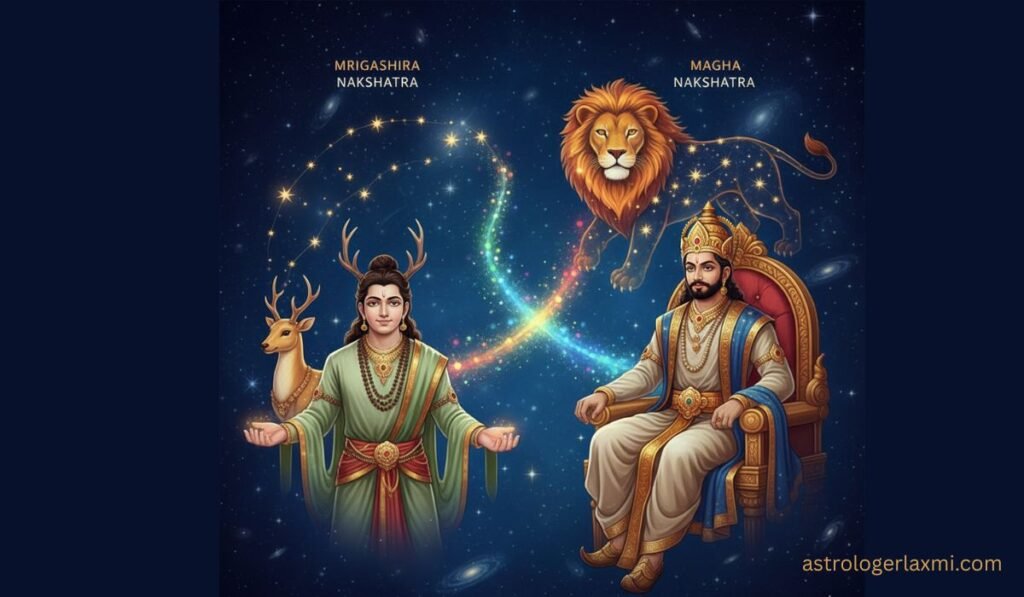
Mrigashira Nakshatra
Mrigashira is the 5th nakshatra, ruled by Mars (Kuja). People born under this star are curious, intelligent, soft-spoken, and creative. They often seek new experiences and love to explore. At the same time, they can be sensitive and restless.
Magha Nakshatra
Magha is the 10th nakshatra, ruled by Ketu. It is a very powerful star connected with ancestors, traditions, and authority. People born in Magha are natural leaders, proud, ambitious, and rooted in their family heritage. They also carry a strong desire for recognition and respect.
When these two nakshatras meet, there is a mixture of curiosity and ambition, gentleness and authority, sensitivity and pride. Let us now see how they perform in Ashtakoot matching.
Ashtakoot Points for Mrigashira and Magha
1. Varna
Varna is about ego balance and spiritual approach. Mrigashira belongs to the Vaishya varna (merchant class), while Magha belongs to the Shudra varna (service class). In this match, the balance is not perfect, and 0 points are usually given.
Personal thought: This may create some difference in spiritual outlook and social approach, but it is not a big obstacle if other points are strong.
2. Vashya
Vashya is about attraction, control, and dominance in the relationship. Mrigashira (in most cases) comes under Chatushpada vashya (animal category), and Magha falls under Nara vashya (human category). In this combination, partial attraction exists, and the pair gets 1 point out of 2.
Personal thought: Attraction is there, but sometimes control issues may arise, especially because Magha people love authority.
3. Tara
Tara checks health, prosperity, and destiny support. Counting nakshatras from Mrigashira to Magha, the relationship comes under a good tara combination. This match usually scores 2 out of 3 points.
Personal thought: This is a positive sign, as it shows mutual support in growth and well-being, though not a full score.
4. Yoni
Yoni represents sexual compatibility. Mrigashira’s yoni is Snake (Sarpa), and Magha’s yoni is Rat (Mushaka). These two are enemy yonis, which makes sexual compatibility weak. So, they score 0 out of 4 points.
Personal thought: This is one of the weaker areas. Physical intimacy may need extra effort and understanding. But I always believe emotional connection can balance this weakness.
5. Graha Maitri
Graha Maitri is about mental and friendship-level compatibility. Mrigashira is ruled by Mars, while Magha is ruled by Ketu. Mars and Ketu share a neutral-to-mixed relationship. Therefore, the score here is 2 out of 5 points.
Personal thought: Conversations and ideas may sometimes clash, especially because Magha is very authoritative while Mrigashira is curious and restless.
6. Gana
Gana shows temperament. Mrigashira belongs to the Deva gana (divine temperament), while Magha belongs to the Rakshasa gana (demonic temperament). This is not a very good match and often creates personality conflicts. The score here is 0 out of 6 points.
Personal thought: This is a challenging area. Mrigashira is soft and polite, while Magha is bold and commanding. Adjustment and maturity are necessary.
7. Bhakoot
Bhakoot shows emotional bonding, family harmony, and financial prosperity. Mrigashira falls in Mithuna and Vrishabha rashis, while Magha falls in Simha rashi. The relationship between these rashis creates a 5-9 bhakoot dosha, which is considered inauspicious. Hence, 0 out of 7 points.
Personal thought: This is one of the toughest parts of the match. Strong planetary positions in the chart are needed to overcome this.
8. Nadi
Nadi is about health and long-term happiness. Mrigashira belongs to Antya Nadi, and Magha belongs to Adi Nadi. Since they are different, it is a good match. So, they score 8 out of 8 points here.
Personal thought: This is the strongest factor between them. Healthwise and genetic compatibility is good, which helps in long-term stability.
Final Score
Now let us add up the points:
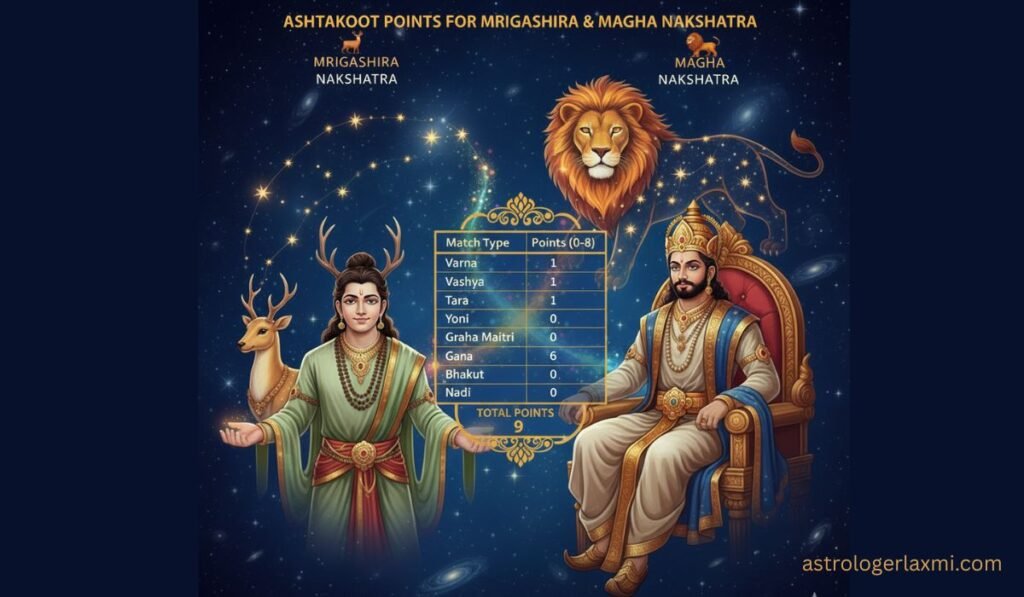
- Varna – 0
- Vashya – 1
- Tara – 2
- Yoni – 0
- Graha Maitri – 2
- Gana – 0
- Bhakoot – 0
- Nadi – 8
Total = 13 out of 36 points
Conclusion
When we look at the Ashtakoot points, Mrigashira and Magha nakshatra match scores only 13 out of 36 points. According to traditional rules, this is considered a low score. There are challenges in areas like yoni, gana, and bhakoot, which may lead to conflicts in intimacy, temperament, and emotional bonding.
However, we must remember that Ashtakoot matching is not the final word. It is just one part of horoscope matching. Other factors like manglik dosha, planetary positions, dasha system, and individual nature also play an important role. Many couples with low Ashtakoot scores still live happily because of mutual understanding and strong planetary support in other areas.
On a personal note, I feel Mrigashira brings curiosity and gentleness, while Magha brings authority and pride. If both partners respect each other’s differences and grow together, they can still make a meaningful bond. Astrology gives us a guide, but love, patience, and trust are what truly make a relationship last..
FAQs
Q1. Is 13 out of 36 points good for marriage in Ashtakoot Milan?
No, 13 points are considered a low score. Generally, 18 or above is seen as acceptable. But remember, Ashtakoot is not the only factor. Other aspects of the horoscope and personal compatibility matter too.
Q2. Why do Mrigashira and Magha score zero in Gana matching?
Because Mrigashira belongs to Deva gana (calm, polite nature) and Magha belongs to Rakshasa gana (bold, dominant nature). These two temperaments often clash, which is why they score zero.
Q3. Can low Ashtakoot points be ignored?
They should not be ignored completely, but low points do not always mean the marriage will fail. If both charts have strong planetary placements and the couple understands each other well, they can still have a successful marriage.
Q4. What is the strongest point between Mrigashira and Magha?
The Nadi matching is the strongest, as they get a full 8 out of 8 points here. This shows good health and genetic compatibility for long-term happiness.
Q5. Why is Bhakoot dosha important in this match?
Bhakoot represents emotional bonding and family harmony. In this pair, there is a 5-9 Bhakoot dosha, which is considered inauspicious. It may create misunderstandings or differences in family life.
Q6. Are Mrigashira and Magha nakshatra people very different?
Yes, they are quite different. Mrigashira people are gentle, curious, and sensitive, while Magha people are authoritative, ambitious, and proud. Their personalities can clash, but they can also balance each other if they try.
Q7. Should a marriage between Mrigashira and Magha nakshatra be avoided?
It depends on the full horoscope. Based on Ashtakoot alone, this match is weak. But if other factors like Moon sign compatibility, dasha periods, and planetary strengths are supportive, then the marriage can still work.
Q8. What is more important – love or Ashtakoot points?
Both are important. Ashtakoot gives us an astrological guideline, but love, respect, and mutual understanding are the foundation of a successful marriage.